Project-based engagements
Single-phase consulting around a specific deliverable — discovery research, engagement facilitation, evaluation framework design, or policy and program review.
3–9 monthsAn arts-focused engagement, project design, and evaluation methodology for communities and the organizations that serve them.
Practice of Place is not a separate service. It is an orientation toward how community-based planning gets done. The approach treats a sense of belonging, creativity, and place itself as the building blocks for better community outcomes.
Most planning treats place as a container — a backdrop where things happen, a site to be analyzed, a context for development. The Practice of Place treats place as something actively cultivated through sustained creative attention. This shift changes everything about how engagement, project design, and evaluation get done.
This reshapes each part of the work. Engagement becomes the core method by which place is understood and shaped. Project design becomes integrated, so that engagement and creative discovery generate the project itself. And evaluation becomes formative: we work with participants to track how belonging gets built into the work as it unfolds.
At its heart, the Practice of Place is a discipline of five principles applied across the full arc of a project’s creation.
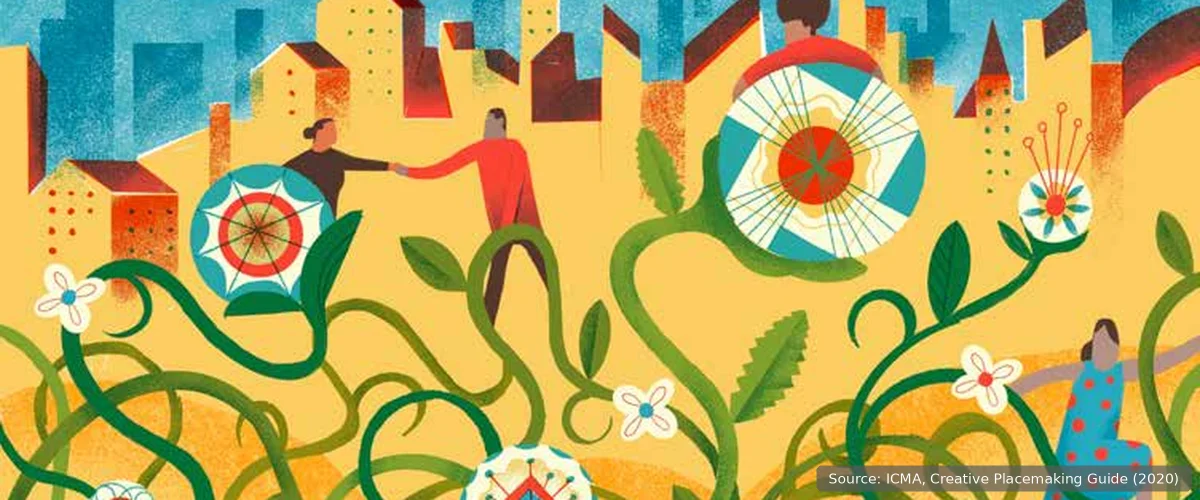
Illustration by Noah MacMillan · noahmacmillan.co.
Whatever the project, these five principles keep place at the center of the work.
Artists embedded in listening and inquiry from the very start.
We bring artists and culture-bearers into the earliest movements of the work, alongside planners and policy leads. They are the ears to the community, framers, and authors of the questions the plan is built around, working alongside the team from the first conversations onward.
This changes the texture of what gets surfaced. Artists notice patterns in a community that planning instruments do not — the cadences of a neighborhood, what is missing from a list of priorities, the difference between what people say and what they make.
Engagement needs to be the relational infrastructure of good planning.
Engagement built on a research-based understanding of belonging. We assess how people feel known by a community along dimensions such as being welcomed, accepted, supported, and needed.
The arts as a way to solve cross-cutting community challenges in health, transportation, and housing.
Cultural plans, public art master plans, and creative placemaking strategies that put the arts to work on cross-cutting community challenges in health, transportation, and housing.
Evaluation that captures what creative placemaking actually produces: relational, cultural, and capacity outcomes.
Built on research-based frameworks, with cross-sector translation capacity that satisfies both philanthropic funders and scholarly audiences.
Long-term partnerships let the methodology deepen over time and build capacity that outlasts any single project.
Long-term implementation partnerships with mission-aligned institutions: county cultural alliances, municipal cultural affairs offices, faith-informed institutions, and anchor nonprofits.
Civic Arts engagements range from focused short-term assignments to multi-year embedded partnerships. Most integrate two or three Practice of Place principles, depending on the client’s actual needs.
Single-phase consulting around a specific deliverable — discovery research, engagement facilitation, evaluation framework design, or policy and program review.
3–9 monthsCultural plans, public art master plans, neighborhood strategies, and program design engagements that move through discovery, design, and validation.
9–18 monthsMulti-year relationships with anchor institutions where Civic Arts becomes part of the implementation infrastructure — typically combining program design, evaluation, and capacity building.
2+ years
Illustration by Noah MacMillan · noahmacmillan.co.
The Practice of Place sits inside a broader field. If you want to go deeper, our published resources document what we’ve learned working with local partners.
We welcome early conversations — whether the work is fully scoped or still just a question you’re sitting with. Let us help you frame the initial questions you’re bringing to the table.